KEYNOTE SPEAKING
RESHAPING how ORGANISATIONS THINK about EXECUTIVE SUPPORT and how EAs THINK about their CONTRIBUTION

THERE'S MORE VALUE in EXECUTIVE SUPPORT than many organisations ARE UNLOCKING
Technology can now do more of the work that once defined an Executive Assistant’s value. At the same time, organisations need more from the people working closest to their most senior decision-makers.
That creates an important question for the profession and the organisations employing it: what should change for the business because this role exists?
Rachael Bonetti’s keynotes explore the gap between the potential of executive support and how the role is often understood, used and measured.
Organisations cannot ask EAs to operate as strategic partners without giving them the context, access and expectations to do so. And EAs cannot expect to be regarded as strategic partners simply because they are experienced, busy or trusted. The value is in what they understand, the judgement they exercise and what becomes possible because they are there.
Drawing on almost three decades alongside CEOs, Chairs and senior executives, Rachael brings a perspective shaped inside the rooms she now speaks about. She understands the work, but she also understands the business around it.
Her talks put language around what is changing, challenge assumptions on both sides of the partnership and show EAs and organisations where more value can be unlocked.
The KEYNOTE TOPICS reshaping how we think about EXECUTIVE SUPPORT
Rachael’s keynotes examine the questions changing executive support now: what becomes more valuable as technology takes on more of the work, what makes an Executive Assistant valuable to a business, and what organisations may be missing when they think about the role.
These are not conversations about doing more. They examine where EAs create value beyond execution, what strong executive partnership requires from both sides, and how greater business understanding, judgement and access can change what an EA is able to contribute.
Rachael’s keynotes can be tailored for Executive Assistant conferences, professional associations, internal EA events, executive and leadership teams, and organisations rethinking how they use executive support.

What Holds Value Now
Why some Executive Assistants are becoming more valuable while others are becoming easier to replace
The Executive Assistant role isn’t disappearing, but some of the work that once made an EA valuable is.
As AI, automation, offshoring and changing business models reshape how work gets done, excellent execution is no longer enough to differentiate an EA.
The opportunity isn’t to compete with technology or add more to an already full role. It’s to understand where value is moving, and build your contribution there.
In this keynote, Rachael challenges familiar measures of EA success and explores what becomes more valuable when execution is easier to replicate.
Judgement. Business understanding. Knowing what matters. Seeing around corners. Connecting information, priorities and people. Understanding not just what needs to be done, but why it matters to the business.
This is a conversation about moving beyond volume as a measure of value and asking a more useful question: what becomes better because you're there?
Audiences leave understanding:
where EA value is moving as technology changes the work
why excellent execution remains essential, but is no longer the differentiator
how to identify the value created beyond completed tasks
where judgement, context and business understanding change the quality of contribution
how to make deliberate choices about where their time, attention and development go next
Making It Easier To Lead
The overlooked executive partnership that can create more capacity at the top.
Leading a business has become harder. Economic volatility, geopolitical uncertainty and rapid technological change are increasing the volume and consequence of decisions reaching senior executives, while their attention remains finite.
Yet in many organisations, the executive and EA relationship is still centred on managing the executive’s activity rather than increasing their capacity.
That is a missed opportunity, and it costs executive capacity at a time when businesses can least afford to waste it.
An Executive Assistant has a vantage point few others share. They can see where stated priorities and actual attention diverge. They see what repeatedly pulls an executive back into the weeds, where decisions are waiting, which relationships need attention and where the way work reaches the executive is creating unnecessary friction.
Across an executive team, that vantage point becomes even more powerful. EAs often see where priorities are competing, decisions are getting held up, teams are working around each other and pressure at the top is creating friction further into the business. Whether that insight becomes useful depends heavily on how the executive team works with them.
Drawing on almost three decades alongside CEOs, Chairs and senior executives, Rachael takes executive teams inside a working relationship most rely on every day but rarely examine. She shows what becomes possible when EAs have the context, trust and access to contribute across priorities, decisions and the flow of work around leadership.
This isn’t about delegating a longer list of tasks. It is about building a partnership that reduces unnecessary demand on the executive and creates more capacity for the work only they can do.
The goal is simple: it should feel easier to lead the business because this partnership exists.
Executive teams leave understanding:
where their own ways of working may be consuming executive capacity unnecessarily
what their EAs can see from a vantage point few others in the business have
why context and access change the quality of judgement and anticipation
how the way executives work creates a ripple effect across their teams, either supporting momentum or creating bottlenecks and reactivity
how EAs can help surface competing priorities, dependencies and friction across the executive team
what to change in the partnership to create more capacity for the work only the executive can do
The Next-Gen EA
The role is yours to reimagine.
There is no single version of the Executive Assistant role. In one organisation, an EA may be used primarily for execution. In another, they are contributing across priorities, decisions, relationships and the work surrounding senior leadership.
The gap is widening.
The next chapter of the profession won’t come from adding another set of responsibilities to an already full role. It will come from questioning inherited definitions of the job and starting somewhere different: what does this business need, and what could executive support become in response?
In this keynote, Rachael challenges EAs to stop using the role they inherited as the boundary of what is possible. To read the business around them, understand what their organisation needs, notice where old ways of working no longer serve it and identify where their time, thinking and capability could be better used.
That also means being willing to let go. Evolution is not accumulation. A bigger role cannot be today’s role with more strategic work piled on top.
Career progression doesn’t have to mean becoming a Chief of Staff, managing a team or leaving the profession.
The opportunity is to think more expansively about executive support itself, and to take greater ownership of shaping a role that responds to where the business is going, not simply where the role has been.
The Next-Gen EA isn’t a new job description. It’s a different starting point: begin with the business, understand what it needs, then consider what your role could make possible.
Audiences leave understanding:
why the future of executive support will not look the same in every organisation
how to read the business around them rather than defaulting to an inherited definition of the role
how to identify where organisational need creates new opportunities for contribution
why evolving the role also requires deciding what no longer belongs in it
why career progression does not require becoming a Chief of Staff or leaving the EA profession
where they can take greater ownership of what their role becomes next.
BUILT FOR WHAT’S HAPPENING NOW
CURRENT THINKING, grounded in REAL EXPERIENCE
Every keynote Rachael delivers is crafted for the room Rachael doesn’t build a keynote once and deliver it unchanged for years. Her thinking keeps moving because business keeps moving.
Her keynotes draw on current business conditions, research and organisational trends, as well as what she is seeing through her work with Executive Assistants, executive teams and organisations. She connects the forces changing business with what they mean for executive support, leadership and the way work gets done.
Every engagement starts with the room. Rachael takes the time to understand who will be there, what is happening around them and where the conversation needs to go. The core thinking remains, while the context, examples and emphasis are shaped for the audience.

Ideas SEEN, HEARD and SHARED in good company


BRING RACHAEL into the ROOM
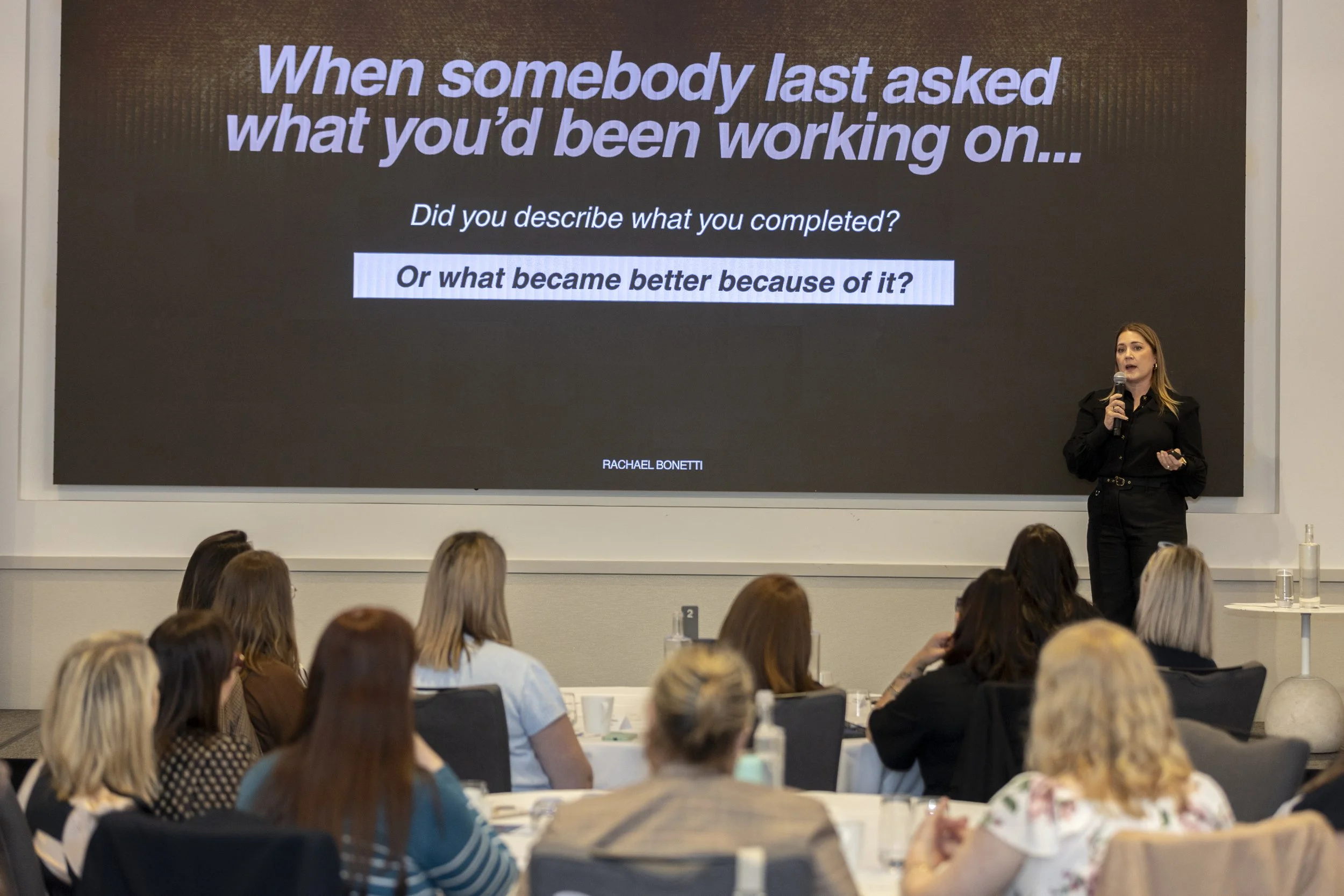
Rachael speaks at conferences, corporate events and executive team offsites across Australia and internationally. Her keynotes are designed for Executive Assistant audiences, executive teams and organisations examining what executive support needs to look like now.
Based in Melbourne, Australia, Rachael is available for in-person engagements nationally and internationally, as well as selected virtual events.
Want the details to share or shortlist Rachael?
Get the Speaker Pack with keynote topics, audience fit, speaker bio and booking information.
Have an event you’d like to discuss?
Tell Rachael a little about what you’re planning.